
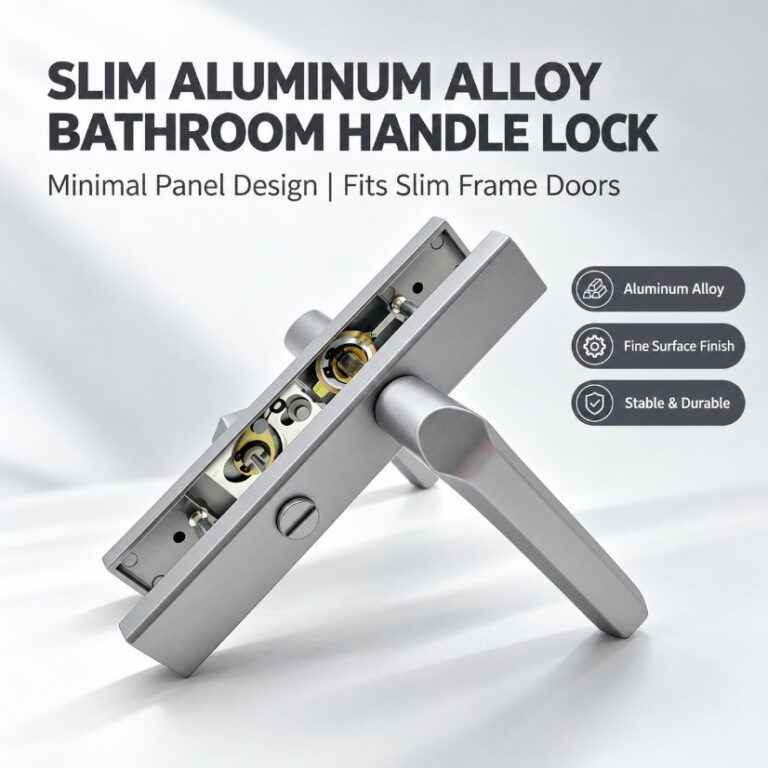
Slim Lock RFQs: Specify the Door Profile View
For a slim lock RFQ, identify the door profile separately from the lock photograph. Send clear views of the relevant door section and ask the supplier to mark the proposed lock interface on a versioned drawing. Record which dimensions, orientations and clearances remain unconfirmed. Treat a narrow-looking handle as a catalogue reference until the supplier confirms the actual pairing.
Name the profile before asking whether the lock fits
Liangjie Locks lists a Bathroom Door Medium-Slim Profile Lock and shows a narrow handle-lock assembly. That reference helps identify the product discussion, but it does not describe the buyer’s door section. A request saying slim aluminum door can leave important differences unresolved. Give the supplier the exact profile reference used by your door-system team, together with the drawing revision or a clearly identified sample.
Keep the door description and the requested lock reference in separate fields. This prevents a supplier response about the appearance of the lock from being mistaken for confirmation of the door interface. If several profiles are being considered, assign a distinct reference to each one. Ask for a separate compatibility response rather than treating an approval for one profile as approval for the whole range.
Request views that explain the interface
Ask the supplier which views are needed to evaluate the proposed pairing. A face photograph can show the visible arrangement, while an edge or section view can clarify the space being discussed. Use the same identifying reference on every view. Include a scale or a dimensioned drawing when available, and clearly distinguish a drawing from an unmeasured photograph.
A close-up alone may hide the relationship between the handle assembly and the surrounding frame. Include enough context to show which surfaces and openings the supplier should consider. Do not estimate dimensions from the catalogue image or assume that a visible gap represents the required clearance. Ask the supplier to identify the information it still needs before making an order-specific recommendation.
Separate confirmed information from open questions
The RFQ should make the status of each interface item visible. A buyer-provided measurement is different from a supplier-confirmed match, and both are different from an unanswered question. Use a simple comparison table so purchasing, the supplier and the technical reviewer can see what evidence supports the proposed configuration.
Information | What the buyer provides | What the supplier confirms
Door-profile identity | Profile reference and drawing revision | Which reference the response covers
Visible arrangement | Identified face and edge views | Proposed lock orientation and matching view
Interface dimensions | Available dimensioned drawing | Marked drawing and unresolved dimensions
Related hardware | Description of the intended mating arrangement | Which associated parts need separate review
Approval status | Named sample or drawing record | Scope and limitations of the confirmation
Ask for a marked response rather than an unqualified yes
A short message saying suitable can be difficult to apply when several drawings have been exchanged. Ask the supplier to identify the exact drawing and mark the relevant interface on its response. If it proposes a different lock version, request the new catalogue reference and an explanation of what changed in the recommendation.
Keep commercial approval separate from technical acceptance. A quotation may identify the offered item without establishing that the buyer’s door system has been reviewed. Ask the responsible technical party to state what has been checked and what remains outside the response. This article does not provide installation dimensions or an installation procedure; the order needs its own confirmed technical information.
Compare offers using the same profile record
When comparing lock offers, send the same profile package to each supplier. Otherwise, one quotation may relate to a different door section or an earlier drawing. Compare the identified lock version, the marked response and the unresolved interface questions before treating the commercial offers as equivalent.
If one supplier requires a revised profile or additional associated hardware, record that proposal separately. Do not describe it as a direct substitute until the buyer has reviewed the changed scope. A useful comparison exposes differences early: what is being offered, which door reference it addresses and what still needs confirmation. It does not rank products by assumed security, durability or certification.
Carry the approved reference into the order
Once the proposed pairing is accepted, keep the approved profile drawing, lock reference and supplier response together. Use their identifiers in the purchase description. If the door profile, visible hardware arrangement or supplier version changes, reopen the relevant confirmation instead of relying on an older message.
Receiving staff should be able to identify the ordered lock version without interpreting the original sales conversation. Ask the supplier how the offered version will be identified in its documents and packages. This is a request for traceability, not a claim that a particular marking service is available. Retain the supplier’s agreed identification method with the final order record.
• Keep the door-profile reference separate from the lock catalogue name.
• Request a drawing-linked response for each proposed pairing.
• Mark unanswered dimensions and changed versions explicitly.
• Retain the approved interface record with the purchase description.
Frequently asked questions
Does a slim-looking lock establish that it matches a narrow profile?
No. Appearance identifies a reference but does not establish an interface match. Ask the supplier to review the actual door-profile information and name the exact lock version covered by its response.
Can a photograph replace a dimensioned profile drawing?
A photograph can explain context, but it should not be used to invent dimensions. Ask which measurements or views the supplier requires, and mark unavailable information as unresolved until a suitable drawing or sample review is agreed.
What should change when the door-profile revision changes?
Send the revised profile reference and ask whether the earlier lock recommendation still applies. Keep the revised response with the order rather than assuming that a visually similar section has the same interface.
What is the most useful approval record?
Retain the door-profile identifier, drawing revision, offered lock reference, marked supplier response and any explicit limitations. These records help the buyer distinguish a confirmed pairing from a catalogue suggestion or an unanswered RFQ.
Product and contact references
Medium-slim lock catalogue reference: https://ljlocks.com/product/bathroom-door-medium-slim-profile-lock/
Related door lock catalogue: https://ljlocks.com/products/?product_filter=%e4%b8%ad%e7%aa%84%e9%97%a8%e9%94%81
Contact Liangjie Locks: https://ljlocks.com/contact/
Liangjie Locks blog: https://ljlocks.com/blog/